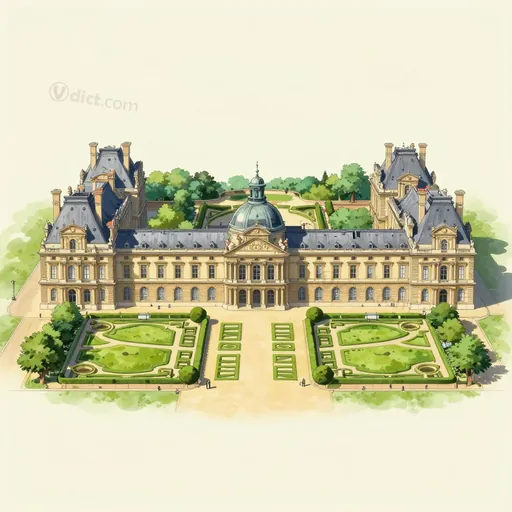
tuileries palace
Definition
Proper noun: * Tuileries Palace: A former royal palace in Paris, France, built in the 16th century for Catherine de' Medici, which served as a royal residence and later a government building until it was destroyed by fire in 1871 during the Paris Commune.
Usage
The term "Tuileries Palace" is used as a proper noun to refer specifically to this historical building. It is often discussed in historical, architectural, and political contexts related to French history. * The Tuileries Palace was a key site during the French Revolution. * After the fire of 1871, only the gardens of the Tuileries Palace remained.
Advanced Usage
- Historical Significance: The palace is frequently mentioned as a symbol of royal and imperial power, and its destruction marked the end of an era.
- The storming of the Tuileries Palace in 1792 was a pivotal event.
- Architectural Context: Used when discussing the layout of central Paris, noting its former location between the Louvre Museum and the Tuileries Garden.
- The Tuileries Palace once formed a grand architectural complex with the Louvre.
Variants and Related Words
- Tuileries (Proper noun): Commonly used as a shortened form to refer to the palace itself, but in modern usage, it almost exclusively refers to the Tuileries Garden (), the large public garden that remains on the palace's former grounds.
- We had a picnic in the Tuileries. (This refers to the garden.)
- Tuileries Garden (Proper noun): The formal garden that is the surviving part of the palace grounds.
Synonyms
- Palais des Tuileries: The French name for the Tuileries Palace.
Noun
-
palace and royal residence built for Catherine de Medicis in 1564 and burned down in 1871; all that remains today are the formal gardens
Khám phá thêm
Các từ liên quan
Từ đồng nghĩa